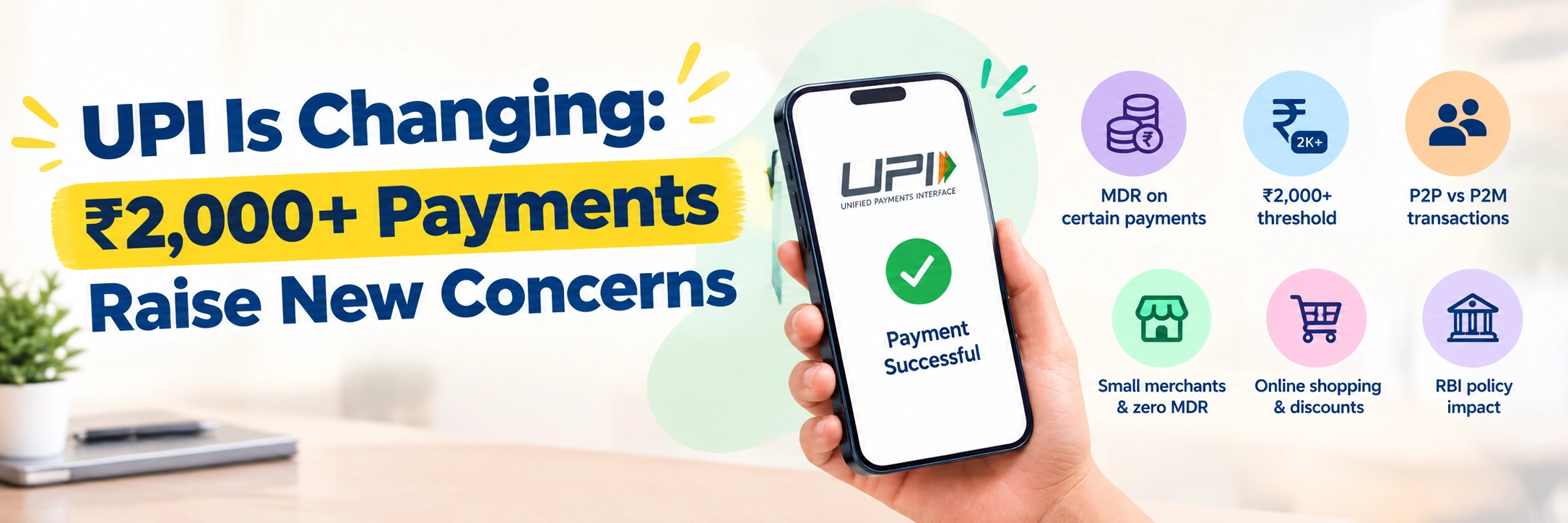
UPI Is Changing: ₹2,000+ Payments Raise New Concerns
Posted on |
UPI Is Changing: ₹2,000+ Payments Raise New Concerns
A new conversation around UPI has left a lot of people scratching their heads.
You may have seen headlines suggesting that UPI transactions above ₹2,000 will now attract a charge. For a payment system that Indians have become accustomed to using for everything from splitting a restaurant bill to buying a phone, that sounds like a pretty big deal.
But there is more nuance to the announcement.
The change is about Merchant Discount Rate (MDR) on certain UPI payments made to merchants. It does not mean that every UPI transaction above ₹2,000 will suddenly cost the person making the payment extra.
At the same time, there are several unanswered questions and areas of confusion around how the new system will work in practice.
So, what exactly is changing and what isn’t?
First, What Is UPI MDR?
Merchant Discount Rate, commonly called MDR, is a fee associated with processing a digital payment. It is part of the payment ecosystem rather than simply being a “UPI fee” charged to the person using the app.
Under the new framework, an MDR of 0.4% applies to certain eligible UPI payments to merchants above ₹2,000.
For example, on an eligible transaction:
- ₹2,500 would generate an MDR of ₹10
- ₹10,000 would generate an MDR of ₹40
- ₹50,000 would generate an MDR of ₹200
- ₹75,000 would reach the ₹300 cap
For transactions of ₹75,000 and above, the MDR is capped at ₹300.
But this is where the first major misunderstanding begins.
MDR does not automatically mean a customer fee.
If you’re paying a merchant ₹5,000 through UPI, it doesn’t mean you should suddenly see an additional ₹20 added to your bill.
The stated framework is designed so that the MDR remains within the payment ecosystem and is not directly passed on to customers as a separate charge.
In other words:
Customer pays ₹5,000 → applicable payment-processing costs are handled within the ecosystem
rather than:
Customer pays ₹5,000 + ₹20 MDR
That distinction is critical.
The ₹2,000 Question: Is Every UPI Payment Above ₹2,000 Charged?
No. And this is probably the biggest source of confusion.
The ₹2,000 threshold relates to eligible person-to-merchant (P2M) transactions.
It does not mean that UPI has a universal rule saying:
“Any UPI transaction above ₹2,000 will be charged.”
For example, sending ₹10,000 to your friend is not the same as paying ₹10,000 to a business.
Person-to-person payment
You send ₹10,000 to a friend.
Merchant MDR does not apply.
Person-to-merchant payment
You pay an eligible business ₹10,000 for a purchase.
The applicable MDR may apply.
So, when you see someone say “UPI above ₹2,000 will be charged,” that statement leaves out a crucial part of the story: who you’re paying matters.
Then Why Is Everyone So Confused?
Because several different ideas are getting bundled together under the phrase “UPI charges.”
There are actually multiple questions hiding behind the debate:
- Is the transaction above ₹2,000?
That’s one condition. - Is it a merchant transaction or a person-to-person transfer?
That’s another. - Is the merchant covered by the MDR framework?
Not necessarily. - Is the merchant a qualifying small business?
That can affect whether MDR applies. - Who ultimately bears the cost?
The framework says it shouldn’t be directly passed to the customer, but the economic impact on merchants is a separate question.
This is why a simple “UPI is now charging 0.4%” explanation can be misleading.
Will Customers Actually Pay More?
Officially, the answer is not as a direct MDR charge.
The framework says merchants should not pass the MDR directly on to customers.
But this is also where some of the public discussion becomes more complicated.
There is a difference between directly charging a customer an MDR fee and a business changing its pricing or payment practices because its costs have changed.
For example, a merchant cannot simply tell a customer:
“Your bill is ₹10,000, plus ₹40 because you used UPI.”
But businesses naturally make decisions based on their operating costs. Whether the new MDR changes prices, payment preferences, discounts or other commercial practices over time is something that will depend on how businesses respond.
So it would be premature to say that customers will definitely pay more, but it is equally simplistic to assume that a new merchant-side cost can never have any indirect commercial impact.
What About Small Shops?
This is another area where the blanket “₹2,000 rule” explanation falls short.
The framework includes provisions that keep MDR at zero for qualifying small merchants receiving up to ₹1 lakh per month through UPI QR payments, subject to the specified conditions.
That means a small neighbourhood business isn’t necessarily going to start paying MDR simply because one customer’s UPI payment crosses ₹2,000.
The merchant’s overall eligibility and the applicable framework matter.
This is particularly relevant for India’s huge network of small retailers, local stores and street businesses where UPI QR payments have become a normal way of accepting money.
Another Grey Area: What Counts as an Eligible Transaction?
This is one of the reasons people are asking questions about the announcement.
The standard 0.4% figure should not be treated as a universal rate for every large UPI payment.
Different categories and sectors can have different arrangements.
Certain areas, including fuel, railways, telecom, insurance and agricultural inputs, have specific MDR structures rather than simply following the standard rate.
So if you hear:
“Every ₹10,000 UPI payment now costs ₹40,”
That’s an inaccurate way to understand the change.
The applicable rate depends on the transaction and merchant category.
What About Online Shopping?
This is another practical question consumers are likely to have.
Imagine you’re doing online shopping for ₹4,000 and choosing UPI at checkout.
The fact that the purchase is above ₹2,000 does not automatically mean you, the customer, should see a separate UPI surcharge.
The relevant question is whether the transaction falls within the applicable merchant MDR framework and how the payment ecosystem handles the charge.
That’s an important distinction because the UPI experience consumers see on their phone may remain exactly the same even though the underlying economics of the transaction have changed.
Is UPI Still Free?
For consumers, UPI is not simply becoming a paid payment method.
Person-to-person UPI transfers remain outside this merchant MDR framework.
Lower-value merchant payments also remain outside the standard ₹2,000 threshold, while qualifying small merchants have separate zero-MDR provisions.
The change is specifically aimed at creating an MDR structure for certain higher-value merchant transactions.
So the more accurate description is:
UPI isn’t suddenly becoming paid. The zero-MDR model is changing for certain merchant transactions.
Why Introduce MDR Now?
UPI has grown enormously, and processing those payments requires a large digital infrastructure.
Banks, payment service providers and other participants have costs associated with processing transactions, maintaining systems, handling settlements and managing security and fraud risks.
For years, the UPI ecosystem operated with merchant transactions largely following a zero-MDR model.
The new structure introduces a mechanism through which certain larger merchant transactions can generate revenue within that ecosystem.
The government has also stated that the framework is intended to preserve free access to everyday UPI payments while creating a more sustainable economic model for payment processing.
What We Still Need to Watch
This is where the story gets more interesting.
The announcement answers some questions, but the practical impact will become clearer only as the system is implemented.
Consumers will naturally want to know:
- Will merchants change their preferred payment methods?
- Will online platforms offer different discounts depending on how customers pay?
- Could businesses indirectly recover additional payment-processing costs?
- How will different merchant categories be treated in practice?
- Will payment apps communicate these changes clearly to merchants and consumers?
These questions are different from whether UPI itself is “charging customers.”
The official framework provides rules around MDR and its treatment, but the commercial response from merchants and businesses is something that will play out separately.
The Simple Version
If all the headlines have left you confused, remember these five points:
- ₹2,000 is not a universal UPI fee threshold.
It applies to specified merchant transactions. - Sending money to a friend is different from paying a business.
P2P transfers aren’t covered by this merchant MDR. - 0.4% MDR doesn’t mean a 0.4% customer surcharge.
The MDR operates within the payment ecosystem. - Small merchants can have zero-MDR protection.
Eligibility and transaction conditions matter. - Not every large UPI transaction follows exactly the same MDR structure.
Certain sectors have separate arrangements.
So, the viral version of the story — “UPI above ₹2,000 will now be charged” — leaves out quite a lot.
The real change is more specific: certain eligible higher-value UPI payments to merchants are moving away from the traditional zero-MDR structure, while person-to-person transfers and several other categories remain outside it.
And that distinction is what consumers need to understand before assuming that their next ₹2,001 UPI payment will come with an extra charge.